Thursday
Sep022010

Whistler

I had enjoyed my time in Vancouver and while the city didn't strike a strong chord it is really a city that leans on its surroundings. Thus, to really appreciate Vancouver you need to explore the outdoor experience that both Vancouver Island and Whistler provide. The island represents a vast piece of wilderness and some solid surfing, Whistler is an iconic North American mountain-town that is a mere two hours drive from the city. The island was too big for me to explore by bike. It would require two weeks in itself and my stab at it left me wanting to get off it due to the concentration of traffic that flows along its few highways. Whistler was always going to be a different proposition.

I followed the beautiful 'Sea to Sky Highway' to the city's nearby mountain playground. The town itself sits at only 600ms and the top of the gondola is elevated a further 400ms up. It's quite hard to believe that a snow resort so close to the coast and so low to the ground would be rated so highly. Indeed, for the Winter Olympics that took place there earlier this year trucks had to deliver powder in from elsewhere. Whistler is considered one of the top, if not the top, snow resort in North America. It feels very much like a resort with all the noise associated with city life left at its doorstep in Vancouver.

What marks Whistler out is that it is a four season resort. As it is privately owned it seeks to earn the very best return on its investment. This means keeping the flow of visitors coming and the only reason to come here is to have some outdoor fun. Visitor numbers are not an issue when you have a major city down the road and the product on offer is of such high quality. Indeed, it seems more like a self-sustaining town than a resort. The people here are mostly local or live in Vancouver and have been here enough times that they know it like a local. Whistler is a full-on skate, bike and board town. All are fully catered for here with the gondola running all year round for both skiers and downhill mountain-bikers. It offers something for everyone, pine forests for hiking, pristine alpine lakes for lounging in the sun and having picnics, a skate-board park, plenty of hills for road-cyclists, a fully set-up mountain-bike park catering for people of all abilities, a gondola to reach the downhill trails and of course a snow season to cater for the full gamut of winter sports. On top, it has a very well planned town-centre full of lively bars and restaurants to provide some good fun right off the slopes. Indeed, the whole town looked as if it had been levelled in advance of the Olympics. In keeping with Vancouver everything is very modern.

I am not the quintessential skater, biker or boarder but I can wing it enough to fit in. Whistler is an absolutely outstanding resort that every boarder and biker should make an effort to get to at some stage. It is difficult to separate Whistler and Vancouver. Both are lucky to have each other; their relationship is very much symbiotic. If I had a choice I would live in Whistler and head down to the city for some culture as opposed to living in the city and having to come up to Whistler. It is really Whistler that allows Vancouver to stand out from the global crowd. In Europe, only Geneva, Zurich, Grenoble and possibly Milan and Munich can vouch for having similar possibilities. In North America it might be only Calgary, Denver and San Francisco that can compete on a similar footing. All are major cities with top-class mountain playgrounds within a couple of hours drive.

The unfortunate thing for me is that I am really a 'roadie' and so I'm more interested in a four season road-bike town than the bi-polar world of a snow-resort. I could be converted but I have a few more races left in the legs such that I require a mild winter climate. In addition, I would have to erase all memories of how hard a day on the snow-board can be when you don't have access the slopes every weekend. The last time I wiped out on a snowboard I was left crying for my mom. It bloody hurts; so much so that if I end up in a snow-resort that I'd be keener to throw snow-tyres on my mountain-bike than whip out my snowboard. Unfortunately the snow-biking scene is fairly random as the people who live in these towns love the duality of the seasons. Why on earth would you go snow-biking when you can have fun on a board? Fair point.

In conclusion, Vancouver is redeemed by virtue of Whistler.

Chat soon

Marco

ps: I managed to post some holiday-snaps of Vancouver in the gallery to give you the picture.

Tuesday
Aug312010

Vancouver

Vancouver is a city with a great reputation in the western world, so much so that the word has spread into the Eastern world. The city not only houses a large Asian population but its trophy properties are being snapped up as investments or second homes by the Asian monied class. I arrived with the sense of annoyance one gets when arriving too late to a really great party; 'what on earth is  going on on here ... what the hell did I miss?' However, the more appropriate question in Vancouver's case is whether the party is in fact over?

Before being allowed to enter the city I was treated to a wonderful striptease as the city peeled off its layers. Exiting the ferry I was immediately impressed by Vancouver's location by the water and at the foot of lofty green mountain-sides. I rode into town along the curvaceous and pretty Marine Drive; one of those leafy byways that shelters prime properties from views of the road while at the same time opening them up to superb ocean vistas. I then had to cross the massive Lionsgate Bridge to downtown. The bridge's span was as wide as Vancouver's welcoming arms hinting at what was to come. It was only after passing the silky waters of English Bay beach and the bush of Stanley Park that I was at last allowed to enter what seemed to be the promised land. I had never seen the likes of it before; a staggering metropolis of modern proportions whose skyline stood like hair on end in a bath of shimmering waters.

My arrival into the city coincided with Gay Pride weekend making accommodation as tight as some guys' trousers. It added a carnival atmosphere to the city with Davie Street simply being off the hook morning, noon and night. I ended up staying in Gastown on the east-side of the city. This part of town has a more boho feel with some great night-life. The city is doing its best to promote it, however, two blocks away is one of the largest homeless populations I have come across yet. I'm not sure what happens next as I have never seen anything like it. On the one-hand the city wants to 'clean up' the area, on the other it is liberal enough not to police it preferring to turn a blind-eye to what happens there so as not to criminalise people who are already burdened. Vancouver's liberal attitude, its booming economy and its hospitable climate make it an attractive destination for homeless people across the nation. The problem is that there are so many of them. Trying to scrounge a buck is an extremely challenging job in Vancouver as there is so much competition. Inevitably, what one saves on a cheaper hostel one loses in charity. However, as tragic as it is they are a fascinating bunch to watch. On the one hand you have the the homeless who are totally destitute and hold no hope. On the other there are those who try not to engage that class of homeless as it drags them down. These people try to maintain their health and dignity when all around others are losing theirs. Some prefer to beg, others prefer to industriously push a trolley of wares. Being offered the choice of three snowboards in the middle of summer for twenty bucks had to make me laugh. The abandoned Indian kid with mental illness who could not count on family or friends for support had to make me cry. The guy who'd do fifty push-ups for a dollar made me wonder about the type of people who actually let him.

While homelessness is the cause I most identify with, a week of living in the conflicting party and poverty atmosphere of Gastown left me wanting to see another side to the city. I had been wandering the back-alleys and lanes trying to capture the city's counter-culture scene before I took a step too far. Having already passed some crack-heads in the lane-ways I stepped back out onto the street only for it to be full of junkies and homeless. There was a squad car parked up and there it was; an awesome shot of dealers and junkies injecting across the street with the cop car in the shot. The first one I took was too distant so I was sizing up a closer shot across the hood of the car, when my periphery sensed a guy circling around behind me. I turned around to face him. It was a junkie asking me what the hell I was doin'. I told him that I was just taking a shot of the car, however, he was smart enough to know my game. Thankfully, I had just the unsuccessful large shot of the car, which I showed him and deleted. A conversation about cameras followed. Suffice to say I soon turned around and retreated to where I came from preferring not to wander any deeper into West Hastings territory with my nude camera. It would have made a great photo but I was not being fair to the guys in the doorway.

Instead of checking out another part of town I stayed in Gastown because of the night-life. The city has a very relaxed ambience and is good fun during the summer with lots of events. I particularly enjoyed watching the original 'Karate Kid' movie in the open-air cinema in Stanley Park, something we just can't do in Dublin because our climate isn't warm enough. Indeed, Vancouver has many strong points, however, I couldn't shake my first impressions that something was amiss. There is something odd about a city that tolerates drugs but not drinking in public or jay-walking. In addition its architecture is ridiculously modern. This marks it out as a town without any history and thus, ripe for invasion by people who are looking for a fresh start. Not a problem in itself necessarily although it may suggest that these people have failed elsewhere. I realise such sentiment is harsh but the city can't seem to shake the fact that it feels like a teenager trying to understand its own identity; being more impressed by ideas from the outside as opposed to forces from within. Its location is superb and it is this as well as its successful economy that appeals to people. However, it is a city built on a service economy and it is this which just adds to the lack of substance to the place. Any city whose 'foundation' is built on the intangible world of bank accounts, insurance policies and legal clauses is a house of cards. From what I can make out there is nothing else going on here. These entities are simply printing presses and while they are printing dollar bills at the moment, the sense is that this is a monster that is feeding on itself and growing into a bigger monster before realising that it is eating itself alive. As is the norm in such scenarios property prices have taken off and there is a wage-price spiral. In the meantime, the city is quite serene and unaware of its fate.

I may be wrong but there is something that feels strange about Vancouver. This is evidenced in its Arts scene, which is purely contemporary and lacking in any sophistication. The city feels very flat and two-dimensional. It lacks texture and that certain 'je ne sais quoi' that truly great cities possess. The people are great but the whole place just smacks of being middle of the road. I really wanted to be seduced by Vancouver but in terms of its reputation it doesn't stack up for me. She is like a young temptress relying on her good looks. Of course, true beauty lies more than skin-deep.

I have no wifi on my net-book so I will upload my holiday snaps in time.

'til soon

Marco

Friday
Aug272010

Island Hopping

The route to Vancouver was to be paved with water. As opposed to heading north to the border overland I decided to take the scenic route via the network of ferries. The first took me west from wharf 52 in downtown Seattle to Bainbridge Island. From here I connected with the highway heading north to the Olympic Peninsula. I ducked off the main route full of summer traffic to hug the coastline visiting Port Ludlow, Port Hastings, Port Townsend and finally Port Angeles. It is this sea-side town that acts as the main access point to both the beautiful Olympic National Park and Canada via the ferry to Victoria, BC.

On arrival into Port Angeles I attempted to bike the 17 miles uphill to Hurricane Ridge, the main view-point for the Olympics mountain range. However, I was running out of light and so I turned back down the hill to the camp-site. My legs were pretty shot so I decided to hitch a ride up the next day. Kevin pulled over in a beautiful Mustang GT convertible - a 2001 model he scored from a guy for a mere $9,000 (the dude needed nine grand to pay for the paint-job on a new car and had to keep his wife sweet by offloading one car to make space for the new one). It turned out that Kevin had grown up in Port Angeles. Like a lot of kids who grow up in small towns, he left as soon as he finished school. This was mostly due to the fact that jobs were thin on the ground as commercial logging activity and fishing were more or less shut down by a more environmentally sensitive government. In addition there were no universities in the area so it was common for kids his age to leave town to go to college. Of course, in the back of his head he believed that life offered more excitement and opportunity elsewhere.

Somehow he ended up in the tornado state of Missouri. A messy divorce had left him with sentiments for home and so he returned for a two-week vacation to visit family and old friends. It had been twenty years since he was last in Port Angeles. I stuck around with Kevin as he was familiar with the park and wildlife. As a kid he and his friends would disappear into the park for stretches of up to three weeks at a time during the summer holidays. A parent would drive them in and then they would hang rations to last them the trip. Once there they would camp, hike, climb, explore, swim and fish until at some point they made their way back to civilisation. It seems remarkable that parents would allow their kids to spend that much time in the back-country unsupervised (without mobile-phones) in the presence of bears, cougars and other wildlife. Of course, this was a time when parents had not been disarmed by fear and so did not have to wrestle with guilty feelings of irresponsible parenting - a recent invention by all accounts. The park itself is beautiful although I did not have time to explore it the way Kevin did in his youth. It had been great to catch a ride up with Kevin, the guided tour and return-trip were a bonus.

I free-wheeled down the mountain to the ferry port. It was time to put the States on ice until I cross the border again in Montana. While I was not greeted with hostility it was the first time on my trip that I had been grilled at a port of entry. I was prepared for it on arrival to the US but pulling the Irish  passport out of the back-pocket worked a treat there so I felt very welcome. In the absence of a return ticket Canadian border patrol were rightly doing their job ... either that or they were just curious to see what the heck I planned to do with all the stuff on my bike. Eventually I was on Canadian soil, albeit not the mainland. I had arrived in Victoria, the capital of British Columbia situated at the southern tip of Vancouver Island. The place totally caught me off guard. I did not expect that I would arrive into little Britain. The name Victoria should have been a give-away but it is very unnerving to arrive in a town that still bows to a Queen thousands of miles away. As nice as tea and scones in the Empress Hotel would have been it was certainly not the Canada I expected. I was totally stunned to find a Paddy-whackery shop full of the usual Irish charms on the main-street of what is a colonial town. I realise that a lot of the people who moved to Canada came from Britain (and Ireland) quite recently and so I don't disrespect their affinity to their roots. However, it was all a bit much for me and so I hatched plans to skip town as quick as I could. Unfortunately it meant a night in the worst hostel of my trip so far - $34 to stay a night in a 42 bed dorm where the door inevitably clicked all night between the comings and goings of so many people. They even tortured us sleepless souls with a huge sky-light that plied our eyes wide open at 6am as the sun bounced up for the day.

I hummed and hawed the next morning wondering what to do. The whole reason for my coming to the Island was because I had met people who told me how amazing the scenery and marine-life is. I wanted to go west but that side of the island has no roads and so I more or less would end up where I started. The only option out of town was to join up with Highway one after taking a ferry across to Mill Bay. Highway one is the Trans-Canada Highway that starts in Victoria and finishes in St Johns' in Newfoundland. It was a nightmare for bikes. Although America has a big car culture I was able to avoid it in Washington State. Plus, they tend to sweep the shoulders in the States so they are safe for bikes. The ride to Nanaimo was far from the island experience I was hoping for. I had to muscle it on a shoulder sprayed with gravel and shrapnel and which dangerously disappeared at points. Having to bike uphill at 10kph without a shoulder while trucks screamed past on the limit was no fun. Once on the island I realised how big Canada is. The island is not made for bikes but for cars. If this is an island then what would the mainland be like? Vancouver 'Island' is in fact a huge chunk of land about half the size of Ireland - another island granted but a country in its own right. In contrast with Eire, Canada is in fact the third largest country in the world. My bike and I started to feel very small.

I decided to get off the island. Biking to Tofino and back for some surfing would have taken me days and so I decided to skip the whole experience altogether. The fourth and final ferry would take me from Nanaimo to Horseshoe Bay; the quieter of Vancouver's two ports. Stay tuned - this city is next up for review.

I trust the form is mighty

Marco

Port Townsend

          the quality bike-path network in WAOlympic National Park

Kevin takes it all back in   

the ferry to Victoria, BC

Tuesday
Aug242010

Sleepless in Seattle


It was a relief to get to Seattle, the ride had been longer and harder than I anticipated. Arriving into city-limits was always going to be stressful due to the increased traffic. Thankfully I pulled over at a bike-shop to seek counsel in terms of the best-route into town. I was pleasantly surprised to receive a bike-map so that I could bike the last 25 miles into the city on bike-friendly routes. This was my first introduction to the Seattle bike scene, which I was not aware of at all. I got to explore the bike network around Seattle even further as an old foe from my triathlon days had invited me around to dinner. I just about had the legs to bike the extra twenty miles to the nearby city/suburb of Microsoft ... eh, I mean Redmond. This meant that I biked forty five miles on bike-paths though the city - quite incredible. The return trip took me along the Burke-Gilman trail which is a bike path that runs by Lake Washington and through various parks along the route. I was as impressed with the ability to be able to bike so many miles through a city on traffic free paths as I was with the amount of roadies I met along the route. It turns out Seattle has one of the biggest 'road-bike scenes' in the US.


I knew very little about Seattle before arriving there save for the corporations that are based there, the coffee scene, the fact that it was considered the home of the grunge music scene in the nineties and that the city is heavily represented across the major leagues: the Seattle Mariners (baseball), the Seattle Sounders (soccer) and the Seattle Seahawks (football) are all based downtown. Their NBA (Seattle Supersonics) franchise was bought by Oklahoma in 2008 due to a disagreement between the Sonics and the city.


I was caught totally unawares by the huge port on the way in. Seattle's location on a map does not suggest that it would be a big port location as large ships have to navigate a narrow channel north of the Olympic Peninsula and there are plenty of islands nearby. It is in fact a massive container port (mostly Chinese containers of course) and also a docking point for massive cruise ships. Typically these large vessels collect local captains on entry to the Puget Sound. These local mariners guide foreign ships through the sound with their local knowledge.


The downtown area is not too big, however, the city sprawls across bridges and waterways giving the metropolitan area quite a big feel. Big cities make for lots of traffic and while they have done a superb job with their bike-route network it makes for a long commute to other parts of the Seattle area. Still, the location is pretty great. They are a short ferry ride to the Olympic peninsula whose long mountain-range provides nice views from the city. On the Eastern side there is Mount Rainier National Park and there are ski-fields nearby in the Cascade range.


It took me five full days to explore the place and it made for a very photogenic city. I particularly enjoyed visiting the downtown public library, which was reconstructed in 2003. This is a landmark piece of architecture by the unconventional Rem Koolhaas. It is symbolic of how liberal the city is as the building strays far from the normal notion that libraries should be stuffy. It has become somewhat of a 'civic-centre' because the city can't afford the cost of building and maintaining a proper one. Like San Francisco, Seattle is a sanctuary city and the homeless tend to hang out in the library during opening hours as they have nowhere else to go. The consequence of this is that the library is unfortunately not wholly embraced by the tax-payers who paid for it.


Seattle is a very impressive city full of outdoorsy people who take full advantage of the lakes and mountains that surround it. Compared to its neighbour Portland, the city is refreshingly diverse and far from sleepy. Its reputation for inclement weather is a little overstated but the cafe and pub scene make for nice places to hang-out indoors whenever the weather does turn sour. The diversity of its inhabitants is best explored through the neighbourhoods that surround the downtown area. These precincts feel like little villages and prevent what is in fact a large city from ever feeling overwhelming.


There are a couple of photo-sets up in the gallery.


Mind how you go

Marco

Friday
Aug132010

Guerrilla in the Mist

The route I chose to ride from Portland to Seattle was literally decided at the last minute. There is a traditional touring route that loops west to the coast and up the Olympic Peninsula; it seemed like the long way round. I didn't want to take the more direct route north as it would mean heavy highway traffic. Thus, I decided to head inland instead to take in the Columbia River Gorge, one of Oregon's main tourist attractions. Doing this would mean taking the mountainous route through the Cascades. Surprisingly or unsurprisingly, I'm not sure which; this is not the route that cyclists take. There are not that many expedition tourers in this part of the world it seems. The standard practice for the tourer here is to avoid hills and I understand where they are coming from if they are not experienced cyclists.  However, as I love the agony of climbing and the ecstasy of descending I don't worry about such things. Touring is nowhere near as stressful or painful as racing so perhaps my perspective is slightly skewed.

This area is reasonably remote as the snowfall during the winter closes the roads, this means that towns along the way tend to be quite basic. Going this route would allow me to take in Mount Saint Helen's National Park and Mount Rainier National Park. These parks don't have through roads making them best explored on foot. Regardless, the snow-peaks are so big that you don't need to trek the actual parks themselves as skirting the parks allows you to still take in the views.

This leg of the trip introduced me to a few problems. The first is that I have just come out of South America where I was spoiled for 'amazing' scenery. In Portland people were telling me how 'amazing' the Columbia River Gorge is and while it is perfectly nice it is far from 'amazing'. Anyone who has seen the Iguazu Falls will understand what I mean when I say that I can't quite look at another waterfall again. Somehow tourist boards have managed to turn the merest of trickles off mountain-sides into 'major' tourist attractions and so the roads were thick with camera-snapping 'tourists'. These are photos I didn't bother to take. I don't mean that in a snobby way, I understand that I am very fortunate to have seen the things I have, it just means that I have to take everyone's view on things with a large pinch of salt. It is more the commercialisation of tourism that I find frustrating. Nature is exploited as a revenue-boosting mechanism where the creed is simply to find ways of boosting 'visitor numbers' so as to improve the local economy. This strips both people and nature of their integrity as we are both merely pawns in the capitalists' game. The result is that pleasant pieces of nature that are converted into 'tourist attractions' almost lose their soul. Visiting them becomes eerily similar to the shopping mall experience where people wander from shop to shop under a thick haze of subliminal stimuli that they are often not aware of. The whole experience just seems sadly vacant.

The second issue was that I was back at lower elevations and closer to the coast where humidity plays a factor. This would mean that I would have to carry a lot more water than I'm used to. In theory, I was sweating what I was l carrying in my dromedary-bag but each litre of water is an extra kilo on the back of the bike. You only notice differences in body-weight when you are in peak condition and are trying to eke top performance from your body for racing. Thus, the fact that I might sweat five kilos is immaterial when touring as the legs can still feel the weight of the water I'm carrying.

The third issue was that I'm back in a developed country and through various means we have managed to make life very expensive for ourselves. Anyone who has had the pleasure of walking around Wal-Mart or Dollar stores to experience the 'frugal future' that some North American economists are espousing can attest to the fact that it is still possible to live cheaply in America. However, the conundrum for me is that cheap food is not nutritious food. My motor is finely tuned at this stage so cheap food for fuel just doesn't work. As a person living off his savings, I'm all for living in the basement of society cutting coupons and scoring meal deals etc. (Become a 'club-card' member of every supermarket chain you visit ... the savings are ridiculous!)

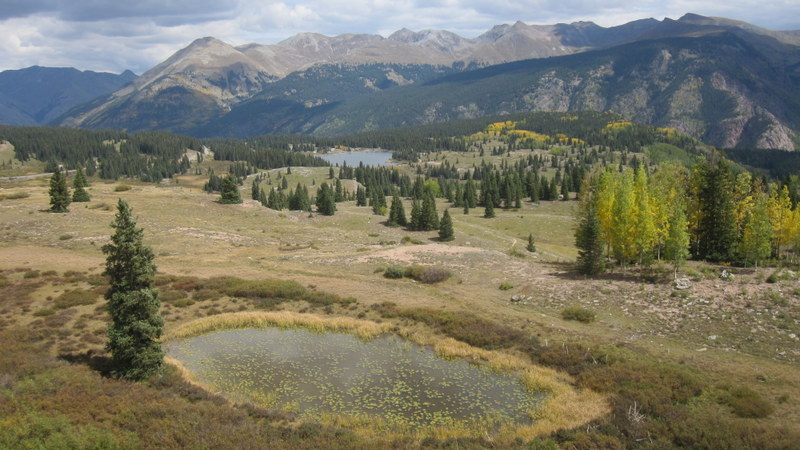
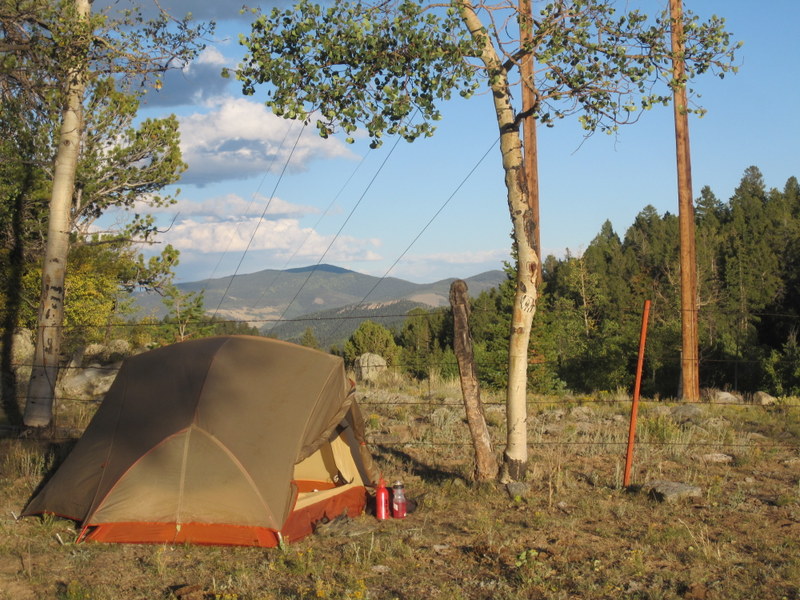
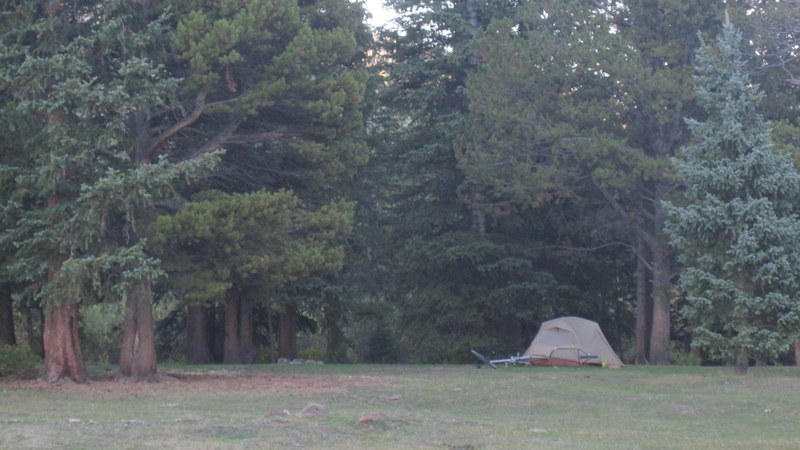
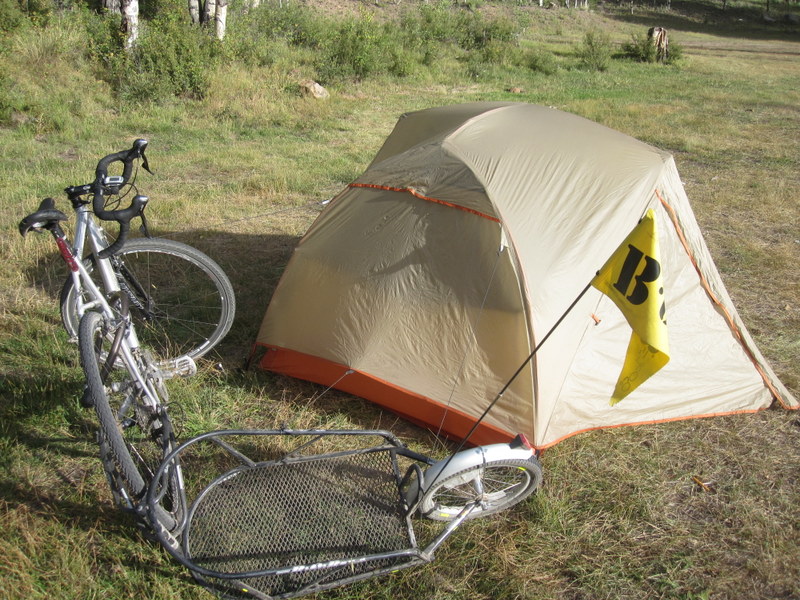
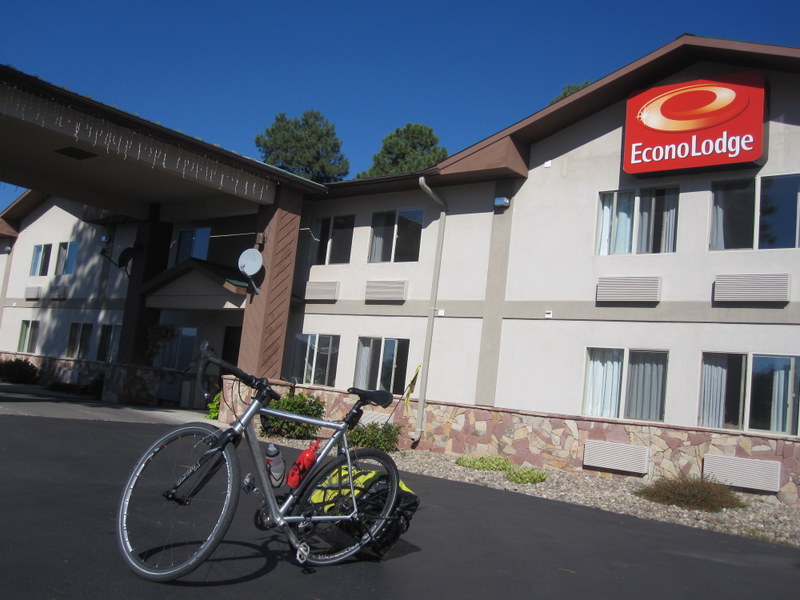
The thrift theme continues in terms of accommodation. I have no problem paying up for hostels in cities; they usually have good locations, provide security for your belongings and can be a good way of meeting people. In the countryside where hostels don't exist then I'm more than cosy in my own tent. It has become my own space to get away from the toil of a travelling day and much like a bedroom it's interior is constant. So no matter where you are in the world the constancy of this internal space is somewhat therapeutic. The problem is that camping can be expensive. In national parks it tends not to be so bad and if you are travelling well-beaten biker/hiker routes it can be quite cheap as the States makes it affordable for people coming into Parks on their own steam. However, if you are off the beaten-path, have no-one to share the cost of a site with and end up in a commercial camp-ground then you are being asked to pay the same price as a hostel for a patch of grass. This intuitively does not make any sense. If I camped for a month I'd be paying $750 to live outside. I could rent a really nice place in a cool part of Portland for that much. Thus, I try to wild-camp where possible. Finding a place to wild-camp is a bit of an art but if you don't do long days and can start early it is not too difficult. The trick is to stock up on food and supplies in a town along the way and then head back into the countryside to find a quiet spot for the night to set up your tent. The benefit is that it is free. The cost is that it can be a little stressful if you can't find somewhere suitable, you are losing light and you don't have a back-up camp-site on your route. A heavily-laden touring bike can make parts of the bush inaccessible, so it generally can take time unless you do short days and happen upon something in the middle of your ride. This only works if you can make up tomorrow what you didn't do today. The essence is that you are camping in the middle of nature and it is quite thrilling when you find nice scenic spots. The trick is to make sure that nobody ever knows that you are there. Unfortunately, perfectly good spots to camp are often in places where it is not permitted. It could be a private farm or a day-use recreation site in a National Park. I am pretty sure that most farmers would be pretty cool to let you camp on their land if you asked, however, farms are automated these days so often there is no-one to ask. In terms of camping in the Cascades, it proved difficult as it is summer-time and the undergrowth is very thick. The forests are dense and being mountainous flat ground can be hard to find. The best spots tend to be places where man has already scarred the land, be it where trees were felled for power pylons or places where loggers or people have cut away the growth to park vehicles off the road. When camping in the wild one needs to be aware of the wild-life around you. Unfortunately the 'wildest' animal out there is man. It is very important to be well hidden from view of the road because humans can be unpredictable. You could be accidentally on somebody's land in a country where guns are an acceptable means of self-defence. In addition, people can be drunk, on drugs or just generally deranged that they might cause you problems. By and large people are fine but you don’t want to startle either them or you.

The term guerrilla-camping is used in North America. This is synonymous with wild-camping, however, I feel that it more suitably describes camping in places where you know you shouldn't or are uncomfortable. This could entail trespassing, which I don't advocate, or more likely camping on state lands where there may or may not be issues. The usual protocol is to set-up under the cover of darkness and to be gone at first light such that no-one could possibly find you. In places such as Washington State where people are very outdoorsy there is not likely to be any problem but it does not necessarily detract from the adrenaline of the situation. The adrenaline tends to fade as soon as you are back in your 'bedroom'; reading, watching TV shows on your laptop or humming to tunes ... all the usual things people do before going to sleep.

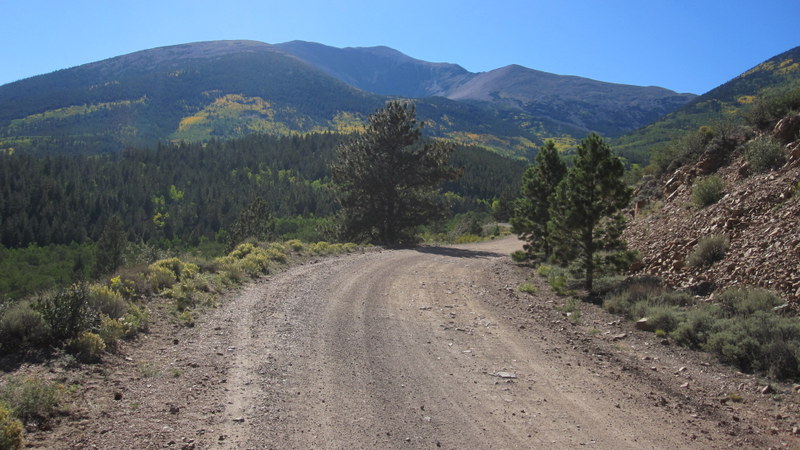
The photos below help convey the ride. As you will note, the weather in Washington State is far from wet as most people think. They tend to get two months of very settled weather during the summer and then experience more drizzly mist than rain in the other months.

Seattle next up.

Marco

Columbia Riverwild-camp Mount St Helens National Park         

Mount St Helen's Volcano

the jackpot - a wild-camp I found where hunters seem to pitch now and again. It even had it's own box toilet in the woods

bottom right there is a crashed pick-up truck I had to phone in - only a cyclist could see it

beautiful wooded terrainI thought it was Mount Adams but it looks like Mount Rainier ... lots of free-standing snow peaks etc

Mount Rainierbath-time in Lake Alder   

guerilla or wild-camp near Alder? This was behind road-signage but I found recent grass clippings near the tent in the morning, which suggested I was on private land. A barking dog in this scenario would have been a disaster       

Friday
Aug132010

Grounded

My camera couldn't stay focused on the job - the motor in the lens cut out. My laptop is suicidal - it jumped off the bed. My horse is bucking - the hub won't freely advance.

Rest assured I have not lost interest in filling you all in ... I just have crap to sort out, which is not so easily done from the road. My trip here seems very busy, which makes staying on top of the blog a little harder than usual but normal transmission will resume shortly ... I hope!

Now, go slack elsewhere

Marco

Friday
Aug062010

Portland

My desire was to ride the beautiful Oregon coast but Portland is situated on the Washington state border and lies 100 miles from the coast. It is the furthest navigable point inland along the Columbia River. Thus, it's location is not practical for what is probably one of the most stunning pieces of riding in the whole of the US. Ideally one would ride the Pacific coastline from Vancouver south to Tijuana as one has a prevailing tail-wind as well as the advantage of being on the right side of the road to overlook the ocean. Unfortunately for me It's a whole separate trip.

Regardless, Portland has always been on my radar. It was the hipsters in Portland who spawned the now global bike-messaging scene. These bike-couriers have added beautiful swathes of colour to many drab cities around the world as they cruise down-town aboard their colourful bikes wearing outlandish fashions. They are the flashes of counter-culture which light up the gloomy shadows of towering financial districts. They are daring Davids among the monied Goliaths with their care-free insistence on stumbling into their thirties living from pay-cheque to pay-cheque. The unfortunate reality is that it is the deadline-kings in rich deal-making firms that allow these hipsters to eke out a living in the first place.

Anyone who has seen Gus van Sant's 1991 road movie 'My Own Private Idaho' would have seen some snap-shots of Portland. This movie documents a journey of self-discovery by two friends (Keanu Reeves and River Phoenix) who hustle on the streets of Portland as rent-boys before embarking on a trip to Idaho and then Italy to find Mike's (River Phoenix) mother. Portland maintains a somewhat seedy edge boasting the most strip-clubs per capita of any US city, however, you have to be looking for them to notice them.

There is very definitely a cool vibe to the place. Everybody has plenty of time to give you the time of day and it seems like the last thing anybody wants to have to deal with is stress. Car stickers encourage people to 'Keep Portland Weird', a slogan which they robbed from Austin - another cool city but all the way over in the shopping mall state of Texas - not so cool. The down-town area is pretty small but nicely sandwiched between water and bridges on one side and beautiful forest parks on the other. It is not a big city by any stretch and the chilled out vibe can almost put you to sleep; wandering the streets after 9pm looking for food is a chore to say the least as most places are shut. Still, the small down-town hub of Portland is surrounded by nice inner-suburbs populated by hipsters and decent folk. Independent retailers, cafes, book-stores and bars bubbling with personality dominate the scene in this part of the world. Franchise supermarkets and eateries are not at all welcome in such precincts. To experience the normal hum-drum existence of regular American life one needs to drift to the outer-burbs to see the bland strip-malls that are now synonymous with US culture.

However, while Portland aspires to being the antithesis of modern day American living, the reality is that it is still just an aspiration. To be fair to them they realise this themselves. The economics involved in maintaining a chilled-out middle-class stress-free lifestyle is such that if no-one wants to work too hard or chase profit then there is not enough of an economy to support all the more expensive hip indie retailers, cafes and bars. A thriving social scene and a vibrant economy go hand in hand. While it is admirable that they seek to halt the damage that is being done to the identity of communities by the dominant chain-stores, the reality is that most people in Portland can't afford to support the indies 100% of the time. It is more likely closer to 15% of the time and the only reason that these stores continue to stay in business is that there is net immigration to Portland as creative types and anarchists seek to move here. The local economy has only been marginally affected by the national downturn. Indeed, the property market has held its own such is the reaction of people across the US who desire to free themselves of the money-culture that was so pervasive during the foiled boom.

I enjoyed Portland a lot. It's a cool hipster town and there is a very healthy local bike scene. Oregon is a great state with the Cascade Range inland and prime surfing on the coast. Unfortunately I spent a lot of time in Portland in bike stores as opposed to on the bike exploring as my tank was destroyed by plane travel. I operated on her in ICU and thankfully she managed to pull through in the end. It was a shame that I was a little stressed worrying about my horse in such a chilled out place. While I didn't get much of a chance to play with the camera I did manage to sample the highlights at least. One of which was (what must be) the biggest and best book store in the world. Powell's takes up a whole city block and encourages people to buy the used books instead of the new ones. Incredibly both are on the same shelf. I have never seen a store with so many classics and that includes the Greco-Roman kind. I managed to procure Douglas Coupland's 'Generation X', Hesse's 'Demien' and Hemingway's 'For Whom the Bell Tolls' all for only 16 bucks second-hand. I am only familiar with F. Scott Fitzgerald, Salinger, Steinbeck and Kerouac in terms of American novelists so Hemingway should broaden that horizon a little.

Portland is cool although a little sleepy. It's a little strange being amongst so many hipsters. If I stayed any longer I'd be walking around in skinny denim cut-offs and waxing the tips of my moustache. The craziest thing I saw was a dude cruising around town on a double-decker bike. He had managed to weld one frame on top of the other such that he was riding 8 feet off the ground.

Still, one question remains; in a city like Portland are the 'suits' the new counter-culture cool?

Be good

Marco

Mount Hood overlooks the city

Tuesday
Aug032010

Saving the Best for Last?

The next leg of the trip has always been the one that I was most excited about. If I had to choose only one leg then it would have been this one. The danger now is that North America disappoints as the truth is that while I have been to some remarkably cool places that I have not yet found somewhere that has truly stopped me dead in my tracks. This puts a lot of pressure on North America to prove that the Dublin suburb of Ranelagh is not the centre of my (the?) universe. The reality is that Dublin is wonderfully located on the periphery of a great continent in a beautiful bay with nice hill-side settings. It is small enough not to overwhelm yet big enough to catch any cultural driftwood that is floating near its waters. In terms of cycling it is the best city I have come across yet. There are very few places in the world that boast a mild enough climate such that one can ride for 360 days a year. It has coastal routes, lakeside routes, lots of twenty minute climbs in Wicklow, nice flat roads in Kildare and Meath, heavy roads for strength and only thirty minutes of city-limits before one swaps the city din for some fresh country air. What's more, there is some great technical mountain-biking and a really great road-racing scene in Leinster once you don't take it all too seriously. The problem with Dublin for me has always been with some of the 'feckin' Irish that live there. Between all the invasions of the Celts, the Vikings, the Normans, the English and the bickering of the indigenous Clanns, has anybody pillaged the city more than that vain breed of Irishman who has exhausted us all both morally and financially?

While money is a reality in the world I inherited it is important for me to be among people who understand the balance. It is for this reason that I wanted to avoid the sea-boards in the US. A lot of the cities on the east and west coast are money focused, be it the glamour of the Hollywood Hills or the competitive ethos promoted by Ivy League universities. This 'race to get ahead' that particularly dominates eastern US thought is something that I wish to avoid. There has to be another way. Thus, I am curious to see whether it is the Cascadian or Rocky Mountain way of doing things.

Another reason why I was so excited about visiting the US is that cities here tend to have a very defined personality. Contrary to European beliefs Americans travel a lot. We believe that because only a small percentage of them have a passport that they don't travel. However, the reality is that they must be among the most travelled race in the world. Everybody who lives here seems to be originally from somewhere else. If you ask an American where they are from they answer where they last lived. Even if I was living in another part of the world I would always be 'from' Dublin. In America people tend to grow up in one town, their parents' jobs or a divorce might move them to another, they go to college in another, they follow a girl/boy to a different one and then they move to settle down in yet another town. This makes them among the most nomadic people on the planet. It was an American writer (Jack Kerouac) who conceived the 'road' novel and inspired a whole generation of drifters. Of course, America is also home to the 'road-trip'. You only have to spend a short time on American highways to notice colossal homes on wheels. Indeed Winnebago and Harley Davidson are world renowned symbols of American transience. The consequence of all this moving around is that they do not have a strong sense of their roots and so search out a place to call home. Sometime between college and starting a family they tend to gravitate towards cities with well defined personalities where they aspire to fitting in. Without the burden of history the United States has managed to foster an eclectic mix of cities; Portland, Berkeley, Santa Fe and Boulder are just an example of some of the many different vibes that exist here. American transience only serves to reinforce each city's personality since only people who want to be associated with it stay. Thus, while America harbours a lot of diversity its cities tend not to be so diverse, unless of course their vibe is the cosmopolitan one of a New York, Chicago or Los Angeles.

To put things in context, the country of Ireland has the population and land area of South Carolina. This is only one of fifty US states. There is no doubt that America is a large piece of land to travel through. Anyone who knows how diverse and beautiful the scenery is here can forgive Americans for never having acquired a passport (even if some cultural awareness would not go amiss).

So, if I'm looking to avoid a lot of the sea-boards then what way do I plan to go? Time to get your google maps out. I start my trip in Portland (Oregon) and will head to Seattle (Washington) via the Cascade range - that's a mountain as opposed to a rifle range! From Seattle I drop out of the Cascades to island hop to Vancouver, British Colombia. From Vancouver I will figure out what way I want to get to Banff in Alberta. Banff is the start of the Great Divide mountain-range, which feeds into the Continental Divide in the US. The whole chain is what we call the Rockies. I am planning to ride what is known in bike-touring terms as 'The Great Divide' as far as Colorado. This is a mountain-bike trail that goes across the Rockies from Canada to Mexico through Montana, Wyoming, Colorado and New Mexico. These are mostly gravel fire-access roads that take me through Glacier, Yellowstone, the Grand Tetons and Rocky Mountain National Parks. While it would be amazing to be able to take my time through it I have to be conscious that the Rockies are generally only free of snow between June and late September. It is for this reason that I hummed and hawed over certain diversions to my trip. The weather in the Rockies has always kept a time-limit on things as I don't wish to wait until the summer of 2011 to ride them. As it is I'm leaving rather late but I have decided not to worry about it and like everywhere else I have been, I'm just going to ride it as I see it. I have unfolded many 2D maps during my trip so far, seeing these maps unfold in 3D as I ride gives me a great deal of pleasure.

In terms of any rush, I take consolation from the fact that there is a race across 'The Great Divide' each June and it takes the winner 18 days to ride all 4,418kms of the Tour Divide race-route from Canada to Mexico self-supported. Naturally, I do not wish to race it (this year at least) but hopefully the weather will accommodate me until I drop off the trail to explore the biker towns in Colorado.

Fingers crossed that I have saved the best for last

Marco

Friday
Jul302010

Gotham City

Wow, yet another new continent and there's no better place to start than in Gotham. It is always surreal to be in the States. You feel like you have to pinch yourself as while the culture is wholly familiar, thanks to Hollywood, it's always strange to feel like you are walking through a real-world set. An 'intermission' in NYC was not part of the original plan for three reasons; firstly it's on the wrong side of the continent to where I want to start biking, secondly a little luxury and some family could derail the rest of the trip for all the obvious reasons and finally, because the longer I wait to bike the Rockies the more likely I will encounter road closures due to the snow that starts to fall in late September. Thus, I always intended to save New York until the end of my 'excellent adventure'. When moving freely in one dimension having to hop back into the other is a little bit of a shock to the system. Needless to say, it was fantastic to see my brother Barry, his wife Pilu and my three year old niece, Sofia, who is away with the fairies. Mom 'n' pops flew in too making the whole thing a real family affair and as big a treat for me as pumpkin pie. We were too big a crew for the downtown appart so we spent most of the time in Barry and Pilu's pretty country home on the NY, CT and MA border in a beautiful part of the Lower Berkshires.

Naturally, I still managed to spend a few days in the city wandering around and taking it all in again. I found it very daunting to be back in a money-centre once more. The velocity of money and its importance forced me to try and extrapolate my future from my current status as a vagabond. I quickly stopped when I realised the massive gulf between me and Manhattanites but I was amazed at how much my head throbbed with thoughts of dollars while I was there. Money is very much a part of the atmosphere in New York. Such cities thrive on the salaries of bankers, insurers and lawyers. Their good or bad fortune determines the vibe of the city's eateries and shops. Manhattan ebbs and flows on the economic tides and no matter how bad things might be for some people there is still a huge amount of wealth left-over. It is very easy to get priced out of the city so as soon as the game is up, you more or less go out a revolving door waving goodbye as if losing out on a quiz show. There is always someone else prepared to try his luck. This means that while prices may move downwards due to the vagaries of supply and demand, the overall cost of living is so high that only the very wealthy can afford to stay. This is one of the reasons why I find cities so provocative. There is always a hub to a city that the prosperous maintain to a very high degree. However, the amount of have-nots that is required to support the haves is huge and so forming one's impression of NYC based on Manhattan is misleading.

I still have a strong impression of my first trip to Manhattan fifteen years ago. Being younger then, I was a little taken aback by the amount of homeless. The flickering flames from steel drums with anonymous faces rubbing their hands for warmth was straight out of the flicks. Today, however, there is very little evidence of the homeless in Manhattan. Somehow Giuliani managed to sweep them down the sewers into the sort of underworld that exists only in 'Batman Begins'. The reality is that all of society's social ills are at their most pronounced in cities. A city without a drug problem, without a homeless community and without both the rich and poor is something out of the 'Truman Show'. Obviously, New York in its totality is just like any other city but it is possible for the prosperous and tourists in Manhattan to lose touch with reality. No matter how much tax one pays is it right to marginalise the have-nots to the sidelines? Levying them with transport costs only acts as a further method of exclusion. Is it fair to promote a policy of out of sight therefore out of mind? Is there not a consequence for society in having people isolated in their own web of thought; the rich fraternise with the rich, the middle class aspire with the middle class, and the working class struggle among themselves. Living in such segmented communities only serves to reinforce the belief system of each. This belief system regenerates in the young who are never given a choice as to what socio-economic group they are born into. In the land of the free, every man supposedly has opportunity if he is prepared to work hard enough. The irony as I see is that capitalist values are exhausting for all those who work, be they rich or poor. Why would anybody want to be tired all the time?

If there was a trophy for the country that provides the biggest culture shock then it would come down to a shoot-out between India and America. I know this sounds strange to a lot of people who consider America familiar, however, I have been here plenty of times and it still never fails to make me wonder. Consider what a Punjabi, who has known nothing but the smells and sounds of India, might make of America? Likewise what would a gas-guzzling do-nut munching Yankee make of a street scene in India? I find the extremes of the States very interesting and so I look forward to trying to unlock the secret of the American Dream as only Cobb could.

Sweet daydreams

Marco

swapping the hustle for the tranquility of the country

Friday
Jul232010

Magic Picchu

I always knew from looking at the map that the citadel of Machu Picchu lies a fair way from the city of Cusco, however, I did not realise how difficult the terrain would be and what a trek it would take to get there. There were a dizzying amount of tours of different types but such choice was hurting my head. I decided to worry about it all later in the hope of meeting somebody with a plan that I could piggy-back. Why procrastinate today when you can procrastinate tomorrow and all that.

This allowed me to sit tight in Cusco and take my punishment for biking too long in too short a space of time. I was definitely exhausted but the local market was around the corner from the hostel, which was where I sucked up a lot of fresh fruit to replenish my stores of vitamins and minerals. Fruit is plentiful in Bolivia too, but they tend to chop it up into small pieces and throw it into a glass of peach juice or liquid yoghurt. Here they can afford blenders so 'combinado' smoothies were the order of the day.

My arrival to Cusco coincided with the Inti Raymi festival, which celebrates the winter solstice and is apparently the second biggest festival in South America. Cusco itself was mobbed and while I'm all up for a party the crowds were all a bit too much, not least the musical beds I had to play in the hostel every day as I had arrived too late to reserve the same bed for my whole stay. The parades in Bolivia are comical because everyone in the parade is getting as drunk as the people on the side of the road but in Peru it was all quite tame. After all the street processions the ceremony itself took place among the Inca ruins behind Cusco the next day. It was the whole reason everyone was in town and while I planned to go up I was suffering from a dodgy Indian curry. Once I could venture beyond the hostel I was delighted to be the only person left in Cusco. I could explore it with the camera without all the goons and people annoying me to buy stuff. By the time I ventured up the hill-side a lot of people were coming down. The ceremony took the whole day and a lot of people who had gotten up early to get a good vantage point on the hill-side were having to bail due to a rumbly tummy of the hunger variety. I don't have to worry so much about vantage points as being tall enough I can pretty much stand behind a crowd of smaller Peruvians and still see what is going on. Not much as it turned out. I was so glad not to have wasted the whole day up there. It was just like going to a Latin mass, even the Quechua were having a hard-time understanding the ceremony. The whole affair was certainly a far cry from the street parties of Lapa or Carnaval in Rio, which is really why the gringos had arrived in town.

Anyway, thankfully the whole thing was over and all the people deserted leaving me to get on with figuring out how to get to Machu Picchu. I had ridden the bike over the really long pass to the pretty market town in the next valley and that pretty much confirmed that there was no way I was ever going to bike there. You'd need an awful lot of time to climb such lofty mountains. While the trekking tours are not badly priced for what they are, I didn't have a whole lot of time available to me. Everything I looked at, even the DIY train route was coming in at more than I wanted to pay. Then, I bumped into my comrades in arms from Isla del Sol and things started to look up. I mentioned before that South America is just like Grafton Street in Dublin for the gringo; there is little chance of anonymity as no matter where you go you will keep bumping into people you know. Tarek and John were also of like-minds in terms of how they wanted to do Machu Picchu - as cheap as possible. Tarek and John had some leads and so I outsourced everything to them with the promise that we would meet up over dinner to discuss. Thanks to them I hit the jackpot; using the network of local buses and 'combis' (mini-van taxis) we could get to a hydro-electric plant and hike two hours along the train tracks to Aguas Calientes, the base-town to Machu Picchu. From there we could hike up the mountain to the citadel itself. So, while we had our plan nailed we were still unsure as to whether we could execute it in the time or as cheaply as we wanted to. I had a bus to catch and so I couldn't really afford too much delay.

John, Tarek, Harry (who I met in the hostel) and I met at the plaza at 7.15am and took a taxi to the bus-station. The taxi-driver told us to use the combi instead as it would be much quicker for not much more money. On arrival at the combi station we got out of the car and were mobbed by men and women as if we were pop idols. Each of them was busy dragging and shouting at us to get into their combi, some quick negotiations and we were on our way out of town. It seemed a crazy way of doing business but then you see them all smiling and chatting once we've made our decision and so you realise it's more a game than business. It would take five hours to make the town of Santa Maria over the Abra Malaga, which must have one of the most dizzying descents I have ever seen. The G-forces were throwing all sorts of shapes in my stomach down the back of the van as the driver was quite enjoying this part. I was a little jealous of the tourists at the summit of the climb getting ready to drop down it on mountain-bikes but then I found out that they didn't enjoy it so much as unless you are experienced in descending then you are on the brakes the whole time, which is pointless. The road itself was asphalt for 95% of it so mental note to self to drop down it on a racing bike one day. One must realise that the elevation of the peaks in Peru are like nothing I have ever seen. Normally valleys are at reasonably high elevations themselves making the peaks not so enormous but here the peaks are stratospheric compared to the troughs.

Our driver made good time despite a road-block and some near-nodding off. On arrival in Santa Maria we were quickly bungled into another taxi to the town of Santa Teresa. We didn't bargain on squeezing more passengers and groceries into the boot but thankfully these people hopped out soon enough to enable us to better cope with the very bumpy drive over another pass. The scenery was stunning and the farming even more impressive. I had never witnessed mountainsides so steep being cultivated but somehow they managed it without stepping them. I would have thought the rains would have washed the seed right down to the valley but clearly not. In Santa Teresa our taxi-driver bungled us into yet another taxi and we were on our way to the hydro-electric plant where we could pick up the train tracks to Aguas Calientes. Our driver seemed more interested in showcasing his western musical collection as his hands were more on the stereo than the wheel but thankfully he got us there in one piece. We had a couple of passengers who had been hiking the 'Inca Trail' and needed a lift. Due to the floods hikers had to change their route and could not arrive into Machu Picchu over the back of the mountain like in the past. For this section they were pretty much walking the road and in the searing heat it could not have been too much fun with bags on their backs etc. Once we started hiking along the tracks we realised that this was a very well-trodden path as we were not walking along the tracks but an actual path alongside the railway line. About thirty people were hiking with us and while we didn't get to town until nightfall, we were met at the end of the line by a bunch of girls who took us to their hostel. It was all too easy. We couldn't believe our luck; we had lovely twin rooms on the right side of town with a great shower for 5 dollars a night each. We were under the impression that we were going to get fleeced here and that the town was a dump. In fact it was a pretty nice place much like a snow-resort that was recently developed and thanks to a great deal of competition both good food and lodging were cheap and plentiful. Tarek had met a couple of friends who reminded us that we should probably pack food with us as opposed to buying it up there ($7 for a coke it turned out). We ended up making the best sandwiches ever and with a healthy does of Sublime chocolate we were well set for our 4am rise.

The reason for rising so early is that there is a peak that sits behind the citadel which only 400 people are allowed to go up each day. Huyana Picchu can only be accessed from the citadel itself so there is a daily race to be within the top 400 people at the gate to see Machu Picchu from this vantage point. The gates themselves don't open until 6am but you don't want to be too early as then you awaiting around in the cold. We set off at about 4.15am in the dark and followed a long line of people with the same idea. Needless to say, if there was going to be a race then I didn't intend to lose it so I started to break a sweat on the narrow track taking people straight up the mountain. It was only 500ms of elevation and as Machu Picchu sits at 2400ms I had lungs full of oxygen for a change. During the hike I wasn't passed at all and while I'm the slowest walker in the world in cities I can hike vertical pretty quickly. I summited just past 5am and in the end I needn't have worried as I was 11th at the gate; the other people before me must have started earlier. Tarek, Harry and John were not too far behind and after doing some market research to see how much we could sell our amazing sandwiches for we entered the citadel.

Unfortunately for me the light was a disaster for photography. The citadel was covered in cloud and so it was a case of sitting around and waiting until it cleared. The advantage of being one of the first in the gate is that you can get photos of the citadel without all the goons in the shot but as we couldn't see anything I would have to make do. By the time the cloud cleared the sun was really strong making that light very difficult to work with also. In the end conditions were too difficult to work with without a brilliant filter and a nice wide-angle lens. We did manage to snag a prime vantage point though by staking out a rock that successfully eliminated an awful lot of goons from the photos. Still, for such an iconic piece of real estate the photo-set is disappointingly bland.

People still don't know the reason for Machu Picchu's existence, whether it was as a country residence for the Indian gentry or whether it was as a big farm for experimenting with crops at different elevations using terraces. Whatever it was it is an amazing site that no camera can truly capture. The citadel itself is impressive but the lush green peaks that surround it are equally so. We had a great time exploring both Machu and Huyana Picchu and once we had demolished 'Machu Picnic' we made our way back the way we came. Our plan had been flawlessly executed until now and while we still needed to negotiate our way back we only managed to come unstuck in the town of Santa Maria. It was too late to get a combi back to Cusco unless we paid double and with the local buses being full we would have to sit it out for the night. However, we didn't give up and when the bus came through town Harry successfully negotiated us on it even though all the seats were reserved. A game of musical chairs ensued as we occupied available seats until people with reservations boarded and eventually I ended up in the aisle flat on my back trying to catch some shut-eye. While it wasn't comfortable I could now relax as I would make it back to Cusco in time to catch my 20 hour bus-ride to Lima.

It was far from an easy journey but the whole thing had been a great adventure as we only had the basis of a plan and so we never knew what to expect. Did we achieve our mission in doing it as cheap as possible, well we couldn't have done it any cheaper. To do a DIY trip by train would have cost about $125 and to take a less flexible tour about $170. Entry to the citadel alone is $43 and we managed to do the whole trip for $72 excluding food. Harry managed to do it for $50 thanks to a student card and while there are easier ways of getting there I doubt we would have had as much fun. Machu Picchu is one of the main reasons so many people visit this continent, for sure it did not disappoint and was a great way to round out my five months in South America.

Some photos are up in the gallery.

Talk soon

Marco